

5 Veterinary Website Optimization Tips To Boost SEO
In today’s competitive veterinary market, simply having a website isn’t enough. If you want to appear on Google and attract more clients, veterinary website optimization is key to standing out online.
The good news? You don’t have to be an expert to make a big difference.
Here are 5 quick website fixes you can make today to boost SEO for vets!
Veterinary Website Optimization #1:
Page Titles and Meta Descriptions
What is it?
When someone searches for a vet, your page title and meta description are the first things they see on Google.
Think of them like the cover of a book: they need to quickly explain who you are and why someone should click!
In short:
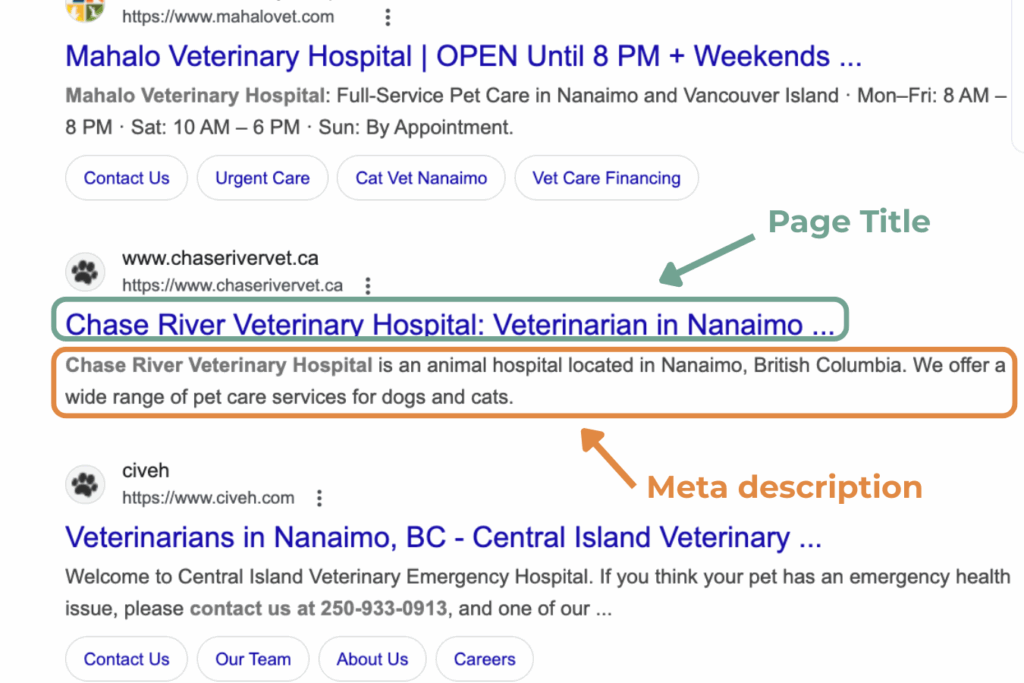
- Page Title Tag: The clickable headline that appears in search engine results and browser tabs.
- Meta Description: A brief summary below the title tag in search results, describing the page’s content.
Check it out below to see how the Page Titles and Meta Descriptions are displayed in the Google results page.
Why does it matter?
Title tags and meta descriptions are often the first thing your potential clients see about your business on Google.
They play a huge role in helping search engines understand your content and in convincing potential clients to click on your website as a potential solution to what they are searching for!
How to optimize?
Page Title
- Keep it under 60 characters.
- Include primary veterinary keywords and your location
- Ensure each page has a unique title tag.
Meta Description
- Keep it under 160 characters.
- Summarize the page content clearly.
- Incorporate relevant veterinary keywords and location.
Bonus Tip: Most website builders used by vet clinics (like Wix, Squarespace, WordPress) let you edit these in your page settings. Look for a section called “SEO settings” or “Search settings.”
5-minute task
Review your homepage’s title tag and meta description. Ensure they accurately reflect your services and location. For example:
Title Tag: “Compassionate Veterinary Care in [City Name] | [Clinic Name]”
Meta Description: “Providing expert veterinary services in [City Name]. Schedule your pet’s appointment with [Clinic Name] today!”
Veterinary Website Optimization #2:
Add Alt Text to Your Website Images
What is it?
Alt text, or “alternative text,” is a brief description of your images added to your
website image settings that help with accessibility and SEO.
- Accessibility: Alt text helps visually impaired users understand what an
image is about by reading the description aloud via screen readers. - SEO: Search engines can’t understand images—but they can read alt text,
which can help improve your visibility.
Why does it matter?
Alt text boosts both accessibility and your veterinary SEO by helping search engines understand your images in a local context.
How to optimize?
content in the image, rather than just describing how it looks.
Naturally include relevant veterinary keywords, like “golden retriever receiving a dental check-up at [clinic name] in [your city].”
5-minute task
Veterinary Website Optimization #3: Implement Internal Linking
What is it?
Internal linking is when you link to other pages or blog posts from your website (e.g.,
linking a puppy health blog post to your puppy services page).
Why does it matter?
Effective internal linking helps search engines crawl your site more efficiently and keeps visitors engaged by guiding them to related content.
How to optimize?
- Identify related pages and link them using descriptive anchor text.
- Ensure each page links to and from other relevant pages.
5-minute task
Go through your website, especially blog posts and service pages, and add links to relevant content that naturally make sense as the next step for website visitors.

Veterinary Website Optimization #4: Create Location-Specific Content
What is it?
Content tailored to your clinic’s geographic area, addressing local pet owners’ needs, is essential for effective local SEO for veterinarians.
Why does it matter?
Local content boosts your visibility in area-specific searches, making it easier for nearby pet owners to find your services.
How to optimize?
- Write blog posts about local pet events or seasonal pet care tips.
- Include your city or neighborhood name in the content and headings.
5-minute task
Draft a short blog post titled “Top 5 Dog Parks in [City Name]” and highlight local spots, including your clinic’s proximity to them.
Veterinary Website Optimization #5:
Fix Your Header Tags
What is it?
Header tags (like H1, H2, H3) are used to organize the content on each webpage. It’s a foundational part of veterinary SEO that’s often overlooked but easy to fix.
- H1 is your main page title (you should only have one per page).
- H2s are for big sections (like “Veterinary Services in Dallas”).
- H3s are used for smaller points under each section.
Think of it like writing a book: the H1 is your chapter title, H2s are your headings, and H3s are subheadings under those.
Why does it matter?
- Helps Google understand your content: Google uses these tags to figure out what each page is about and rank it properly.
- Boosts local SEO: Including your location in headers (e.g., “Wellness Exams in Portland”) helps your clinic show up in local searches.
- Improves user experience: People can quickly skim and find what they’re looking for — whether that’s emergency services or puppy vaccinations.
How to optimize?
- Use just one H1 per page, usually the page’s title (e.g., “Veterinary Clinic in Chicago”)
- Use H2s to break your page into sections like:
- “Dental Care for Dogs & Cats”
- “Vaccination Services in Boston”
- “Why Choose [Your Clinic Name]?”
- Use H3s under each H2 for supporting details (e.g., under “Dental Care,” you could have “Puppy Dental Cleanings” or “Senior Pet Oral Health”)
- Include keywords + your city name naturally where it fits.
Imagine your “Services” page has this headline:
❌ “What We Offer” — vague and not helpful for SEO.
✅ “Veterinary Services in North Vancouver” — clear, keyword-rich, and location-specific.
Then use H2s like:
- “Preventative Pet Care in North Vancouver”
- “Veterinary Surgeries for Cats and Dogs”
- “Emergency Vet Appointments Available”
5-minute task
Open one of your main pages (like your Services or Home page). Use the free Chrome extension Detailed SEO and check:
- Is there only one H1?
- Are your section titles using H2s, not just bold text?
- Could you naturally add your city name to any headers?
If yes — update a few headers with clear wording and your location!
Conclusion
By implementing these quick fixes, your veterinary clinic can enhance its local SEO with practical veterinary SEO techniques designed for busy clinic owners.
Regularly updating and optimizing your website ensures sustained visibility and growth in the competitive digital landscape.